
Mystery of 180-year-old medal solved
The Royal Scottish Highland Games Association (RSHGA) got a surprise this week when a message arrived from the USA seeking help to identify a 180-year-old family heirloom.
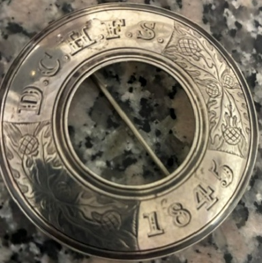
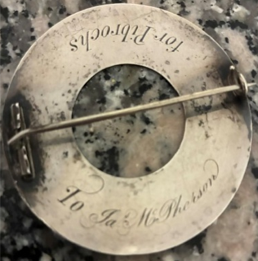
Bruce Cameron Williams of New York contacted the RSHGA to say that 40 years ago, when visiting family in Inverness, he was given a silver plaid brooch with an inscription that has been a mystery for decades. The front is engraved with thistles, the date “1845” and initials “D.C.H.F.S”. The back is engraved in an elegant script “To Jas McPherson for Pibrochs”.
Being a bagpipe player himself, Bruce was keen to find out more and was delighted when Alasdair MacDonald at the RSHGA was able to immediately identify the awarding body as the ‘Dunkeld Caledonian Highland Friendly Society’. Alasdair was also able to point to a press article from the Perthshire Advertiser of 10th July 1845 which reported that at the meeting of that society, a “handsome silver Brooch” was presented for Pibroch to J. McPherson, Fonab. In a twist to the tale, it was also reported that he was judged to be the “best attired Highlander” and awarded “a silver-mounted Snuff-Mull”.
Further research revealed that Jas. McPherson was one of the Pipers to Lord Glenlyon of Blair Atholl; other contemporary press reports show him winning more Pibroch competitions. Bruce was delighted to hear all this – the search is now on for the Snuff-Mull!
If you want to read more about the background to this, here is an account provided by the originator of the enquiry, Bruce Cameron Williams:
The “D.C.H.F.S.” Silver Prize “For Pibrochs,”
won by Jas. McPherson at Dunkeld in 1845,
and how it made its way to America.
In 1982 or 1983 Northwest Orient Airlines inaugurated non-stop air service from Scotland to Boston, Massachusetts. To introduce this new air route to Scottish travel agents, they were flown to Boston for a gala event convened at a nice hotel. The marketing manager called to engage my services as a bagpipe player to “Pipe Them In” to the dining room on the first night. We haggled a bit about my fee, until we agreed they would provide a first-class round trip ticket between Boston and Prestwick in lieu of cash. This arrangement cost the airlines not a penny, and the value was vastly greater than the amount I would have charged for my services. So each of us was satisfied, and perhaps thought we had got the better of the opposite party.
On the night of the hotel event, my ‘pipes sounded sweet, tuneful, and resonant, and I was satisfied with my efforts. Everyone appeared to enjoy the music, and I booked my flight for later in the year.
Thus it was that in November, 1983,shortly after landing at Prestwick, I was walking on Sauchiehall Street, when a gentleman stopped to say he knew me. I told him it was impossible because I had only been breathing the air of his hemisphere for two hours. Then, he exclaimed, “ I’ve got it! You are from Boston, and you play the bagpipes!” Well, he certainly had me there.
He had been one of the travel agents I had piped to table some months earlier. He told me that the Boston travel agent dinner had been videotaped, and the images of me piping the guests into the dining room had been shown all over Scotland on the evening news for a couple of days. Thank goodness my bagpipes were in good trim that night, since my playing was broadcast to every house in the Land.
In Glasgow, I visited the sister of my wife’s mother, Mrs. Elizabeth “Betty” (Ross) Haig, who insisted I go to Inverness to meet her and my mother-in-law’s family. Since they were my family by marriage, she had already arranged for me to stay with her elderly aunt there, Mrs. Margaret Elizabeth (Shand) Cameron, widow of Duncan Cameron. I said that I preferred to stay at a hotel rather than insert myself into the home of a complete stranger. But Aunt Betty told me it had already been arranged, Mrs. Cameron was agreeable, so I assented to the plan rather than give any inadvertent offense to either of the aunties,
Before I boarded the train from Glasgow to Inverness, I was counselled thusly by Aunt Betty, ”Now, I know Americans like to bring gifts to their hostess when arriving for a visit. But if you bring a gift to my aunt, she will consider it charity. She will be offended by a flashy American distributing trinkets to what he perceives to the inferior indigenous tribal people of Inverness. Having you as her guest is her honor as well as duty to a kinsman. So do not bring her so much as a tea bag or lump of sugar, else she takes umbrage.”
A few words about this family in Inverness. The Shand family and the Ross family in the late 1800’s and into the beginning of the 1900’s lived in Inverness in two cottages on Shore Street, literally on the banks of the river Ness. One cottage was called “Citadel Cottage,” and the other was “Ness Side Cottage.” “The Citadel Pub” was situated in the immediate vicinity, which displayed photographs of the local football team. Colin Ross (born 1899) was one of the footballers shown in the team photos. Colin was a butcher in Inverness, as was his father Alexander Ross (born ca 1863), who married Elizabeth Shand (born ca 1862). In World War I, Colin Ross joined the 3rd Battalion, the Queen’s Own Cameron Highlanders.
Colin had married in 1915, Mary McKay. In 1917, Colin and Mary’s daughter, Margaret Violet Ross was born in Haddington. Margaret Violet Ross married Alvin A. White after the second World War, and moved to his home in Massachusetts, where I would marry their daughter Nancy in 1978. During World War I, Colin Ross was severely injured on the battlefield by an exploding artillery shell, and left for dead. He was captured by the Germans, and taken to their Field Hospital. The German doctor said that Colin’s left arm had to be amputated. He explained to Colin that if they were in the doctor’s operating theater in Cologne, Germany, Colin’s right arm could be saved. He went on to say that he was there to save lives, rather than limbs, and the extra time it would take saving Colin’s “good arm” might lead to the deaths of soldiers on both sides who needed the doctor’s attention. So, the German doctor intended to amputate both of Colin’s arms in the interest of saving time. Colin cried out that if there was a way to leave him with one arm he would really be appreciative. The doctor said “My wife writes that it is impossible to acquire wool in Germany due to wartime shortages, and consequently she is unable to make new skirts for our two daughters to wear to school.” He told Colin that if he would give the doctor his kilt to send to his wife, the doctor would save Colin’s right arm. And so it was that two little girls in Germany went to school wearing wool skirts of the Cameron of Erracht Tartan, and an injured Private of the Cameron Highlanders returned from the War with one arm rather than none.
Returning to my train ride from Glasgow to Inverness; after leaving the Inverness railway station, I walked to Mrs. Margaret (Shand) Cameron’s home. I was on the horns of a dilemma about how to not offend her with a gift, while not embarrassing myself by being a guest in the home of a total stranger for three days and nights without “Chipping in” somehow. As I walked and pondered, I passed a little shop which displayed in its window an enormous bottle of Famous Grouse Whiskey. Mindful that I was to be the guest of a complete stranger for three days and nights, and wishing to present a gift more or less commensurate with such hospitality, I entered the store and asked if I could purchase the article in the window. The shop owner placed a normal size bottle of Famous Grouse on the counter. When I told him I wanted the towering bottle in the window he called out excitedly to the rear room of the shop, “Lizzy, a Yank is buying “The Sovereign” right out of our window!”
I placed the bottle into my suitcase, which was not as easy as it sounds because of its massive dimensions, and made my way to Mrs. Cameron’s home rehearsing how I would present this gift as inoffensively as possible.
When I arrived, Mrs. Cameron was very proper and civil, introduced me to her lovely home, showed me where I was to sleep, and then offered tea in the front room. We spoke about the weather, she hoped my train ride was pleasant, she asked politely about her niece (my mother-in-law), and about my life and family in Massachusetts. She was formal and courteous, but not what would be called sweet or welcoming from an American point of view (which is to say she did not cry out “Howdy, Pardner,” while embracing me in a crushing hug.). After we had exhausted conversation topics, I said I hoped she would not misunderstand nor in any way take amiss the American tradition of presenting a “thank you gift” for hospitality.
She immediately began to express that she would not hear of it, such was not at all necessary, she was happy to be my hostess, she neither wanted nor needed any presents, and so forth.
When I hauled (with two hands) the “Sovereign” bottle of whisky from my suitcase, her face immediately relaxed from its previous reserved formal aspect and assumed an expression of pure pleasure. She then leaned forward to pat me upon my knee saying, “And ye shall call me Auntie Maggie.”
During the next three evenings, the elderly ladies of the neighborhood came by to share the contents of the enormous bottle. The news of this apparently inexhaustible quantity of Famous Grouse spread far and wide, with the result that each evening there were twice as many visitors as on the previous night. The first night the guests were in the kitchen, the second night the kitchen and the front room were filled. The third night overflow guests were standing outside. The dear old grannies fortified their drams with lemonade, and they enjoyed themselves for hours at Mrs. Cameron’s nightly ceilidh. And none of them enjoyed themselves more than she.
Auntie Maggie was the world’s most attentive and gracious hostess. She crept into my upstairs sleeping chamber before dawn each morning to purloin my soiled clothing from the previous day, which when I came down was already washed and hanging from the kitchen ceiling on a wooden article that looked like a fishing creel attached to a rope and pulley. By the time I left her home, dozens of very cheerful neighborhood ladies within an ever-expanding radius had spent hours sitting at the kitchen table beneath my underwear and socks, drinking Famous Grouse Whiskey augmented with lemonade.
Auntie Maggie Cameron’s breakfast was always epic: scrambled eggs, fried haggis, porridge, canned fruit, scones, jam, butter, and tea. I later learned that each morning she walked to the butcher shop to purchase the fresh haggis for my breakfast. She was beyond gracious to me; in fact she was very dear, always taking my arm as she introduced me to yet another neighbor lady with an empty glass. Over forty years later I remember my time spent with her in appreciation and affection.
Two things Auntie Maggie recommended I do while visiting Inverness: firstly to walk down to the River Ness on Remembrance Day Sunday to see the ceremony at the Cenotaph, and secondly to pay a visit to her sister, Jessie (Shand) Roy, who in 1935 had married James Alexander Roy.
As instructed by my hostess, I walked down to the River Ness to observe the Remembrance Day ceremony. When I arrived at the assembly point on “this side” of the river, a group of about fifty World War II Veterans were loitering about, slouching, smoking cigarettes, hands in pockets, and speaking among themselves. Their average age I would guess to have been in the early seventies. Each was dressed smartly in shirt and tie, sweater vest, tweed jacket with military decorations displayed upon the left breast.
Most of the men wore either a military diced Glengarry cap or Balmoral bonnet with regimental badge and feather hackle. I was surprised to observe one or two Black Watch red hackle feathers asserting themselves within a sea of Cameron Highlander cap badges.
A very few minutes before the official event was scheduled to commence, a military truck arrived to disgorge a group of kilted soldiers, ‘pipers, and a Colour Guard from the 79th (Queen’s Own Cameron Highlanders) barracks at Fort George. The soldiers formed up in about two seconds when their sergeant barked out an order. At the sound of command, the years fell off the old Veterans. Gone were the cigarettes, the slouches, the stooped shoulders, hands in pockets, as they lined up immediately in excellent formation. When the order “Quick March” was bellowed, the drums rolled off, the pipes struck up, and each man set off in a dignified march with arms swinging high. Perfect unison and deportment. Eyes front. Shoulders back. Bemedalled chests out. The early years of training and drill had come right back forty-five years and more after military service.
If there was a ship there for them to file into to go fight the Germans in the afternoon, these men would have boarded readily while singing “Scots Wha Hae”…. The brave auld heroes!
At the Cenotaph speeches were made, the pipers played “Flowers of the Forest.” Then the “Last Post” was bugled by one of the side drummers, at which time all the flags were swept across the ground. This was a thing I had never seen (in America the custom is to never allow our Flag to touch the ground), and I considered the spreading of the flags upon the ground to be an expression of the very deepest respect to the heroic and tragic Fallen to whom so much will forever be owed. The ceremony was intended to be emotional, and I was very moved.
After the conclusion of the official observations at the Cenotaph, the soldiers reformed, the colour guard took up its position, the Veterans lined up all proper and correct, and at the barked command of the serjeant, the soldiers old and new, followed by we spectators, marched back along the River Ness to the formation area, walking in time with the cadence set by the pipes and drums. Falling in behind the old soldiers I had such respect for them as they swung along, as if they were nineteen years old again. I enjoyed the billowing flags, the rhythmic swinging of the pipe tassels and pleats of the kilts, and the fluttering of the ribbons at the back of the Glengarry caps in the glorious morning sun. The entire event was very well done as well as poignant. As the son of a World War II U.S. Navy submariner and a descendant of Scottish soldiers, I felt solidarity with the solemn ceremony. I am to this day appreciative that Auntie Maggie Cameron recommended that I attend.
After the service at the Cenotaph, the men moved into the tap room at the British Legion Club.
One of Auntie Maggie’s sons told the soldiers that I was a piper from Massachusetts. The soldiers told me that the “Worcester (Massachusetts) Kilty Band” had been to Inverness a short time previously. When I said that the Worcester Kilties were one of the best pipe bands in America, the Scots replied, “We know, because they told us many times while they were here!”
The next thing I did was to follow Auntie Maggie’s second recommendation, to visit her sister, Jessie (Shand) Roy. We had a lovely tea, and Auntie Maggie told her sister (who was by then my “Auntie Jessie”) that I was a bagpiper. Upon hearing this news, Auntie Jessie left the room, and returned with a silver plaid brooch, engraved with thistles, and the initials “D.C.H.F.S.” in chief, and “1845” in base. On the reverse was engraved in an elegant script, “To Jas. McPherson for Pibrochs.” Auntie Jessie said it had been in the family forever, and she was very happy to present it to me in order to keep it in the family and in the hands of a ‘piper. So gracious and welcoming to me she was, and I was very honored.
So, the visit to go see a little old lady in Inverness that was more or less a compulsory family obligation, turned out to be a very fulfilling opportunity to meet and be accepted by distant relatives, to experience gracious and loving highland hospitality, to share in Scotland’s military traditions, to pay respect to the Scottish soldiers, sailors, and airmen, living and dead, to immerse myself a little bit into the wonderful Inverness culture, and to be given this wonderful and historic Pibroch prize brooch.
Auntie Maggie (Shand) Cameron passed away in 1994. Auntie Jessie (Shand) Roy passed away in 2007, Auntie Betty Ross Haig in Glasgow passed away, too, as must have all the old soldiers who marched behind the Colour Guard along the River Ness on that beautiful sunny November Sunday in 1983. Indeed, even the Queen’s Own Cameron Highlanders Regiment (the 79th) that provided the active duty soldiers that day has passed from the scene. I am so glad I had the opportunity to be with them all for those few wonderful days.
I have displayed the Silver Pibroch prize brooch for over forty years, always wondering what the initials were trying to tell me. I wrote to everyone I could think of for information, including Scottish newspapers, magazines, Highland societies. After home computers became available, I googled again and again, but was never successful.
Then, one recent day, I located online the Royal Scottish Highland Games Association, and sent an email requesting help. In less than 24 hours I received the most remarkable response from one of their Members, Mr. Alasdair MacDonald. He emailed that the genesis of the brooch was the Dunkeld Caledonian Highland Friendly Society annual games of 1845. Additionally, Mr. MacDonald provided a contemporaneous newspaper article that memorialized the very date of the event, and reported that the brooch was presented to J. McPherson as second prize for the pibroch competition. Mr. MacDonald went on to say that Mr. Mcpherson, who was one of the pipers to Lord Glenlyon (later the sixth Duke of Atholl after the death of his brother), also won the Best Dressed Highlander prize on the same day. So, James McPherson was clearly in excellent form in 1845.
I have always treasured this brooch because of what it is, and for the way it was given to me from the most distant of Inverness relatives on that very moving Remembrance Day Sunday above the banks of the River Ness. Today, over forty years later, I am enjoying it all the more thanks to the helpful people at the Royal Scottish Highland Games Association, and in particular to their scholarly, professional, and friendly expert, Mr. Alasdair MacDonald.
Bruce Cameron Williams
New York, 2026